
15 Jul 2026 By DREW KIM
BOUCHERON UNVEILS CARTE BLANCHE 2026 HIGH JEWELRY COLLECTION , HUMAN BEING
looking at what connects us, then drawing
closer to discover what sets us apart.
This year, Maison Boucheron dedicates its Carte Blanche to what is most precious of all: the Human Being. Through five jewelry sets, Claire Choisne and her studio highlight the similarities that bring us together and the differences that make each of us unique. One and the same shape runs through every creation – yet each one calls upon a different savoir-faire. Within each creation, subtle nuances emerge: a play of volume, gemstones and light, like so many expressions of our individuality. The closer you look, the more you discover, as in each of us, those details that define who we are. With this new Carte Blanche Collection, Boucheron celebrates being rather than seeming.
Every year, the Carte Blanche Collection gives Claire Choisne an opportunity to reflect anew on what is considered precious. In 2024’s “Or Bleu”, she explored the increasing scarcity of water; in 2025, she addressed the disappearance of nature through “Impermanence.” This year, the creative director makes the case that, in an ever more artificial world, what is truly precious is humanity. Choisne is a jeweler by training, with a keen appreciation for the technical mastery that only human hands can attain. She believes that nothing will ever supplant human creativity and artisanal craftsmanship.
How could we find what connects us?
Claire Choisne decided to focus on an archetypal form of High Jewelry necklace to represent this common denominator. She settled on that great classic, the cluster necklace, with its grouped stones forming a unified composition. This core design is reproduced in five very Boucheron jewelry sets, each consisting of a necklace and a ring.
How could we find what sets us apart?
In this collection, a diversity of savoir-faire, colors, and materials are employed to express our distinctive qualities and to endow each set with its own emotional character. This collection presents a profoundly human vision of High Jewelry, where artisans from very disparate realms bring together their skills, technical know-how, and artistry. Between them, they spent over 14,000 hours crafting the collection, a testament to the breadth and brilliance of the savoir-faire involved.
RAIN
 |
|
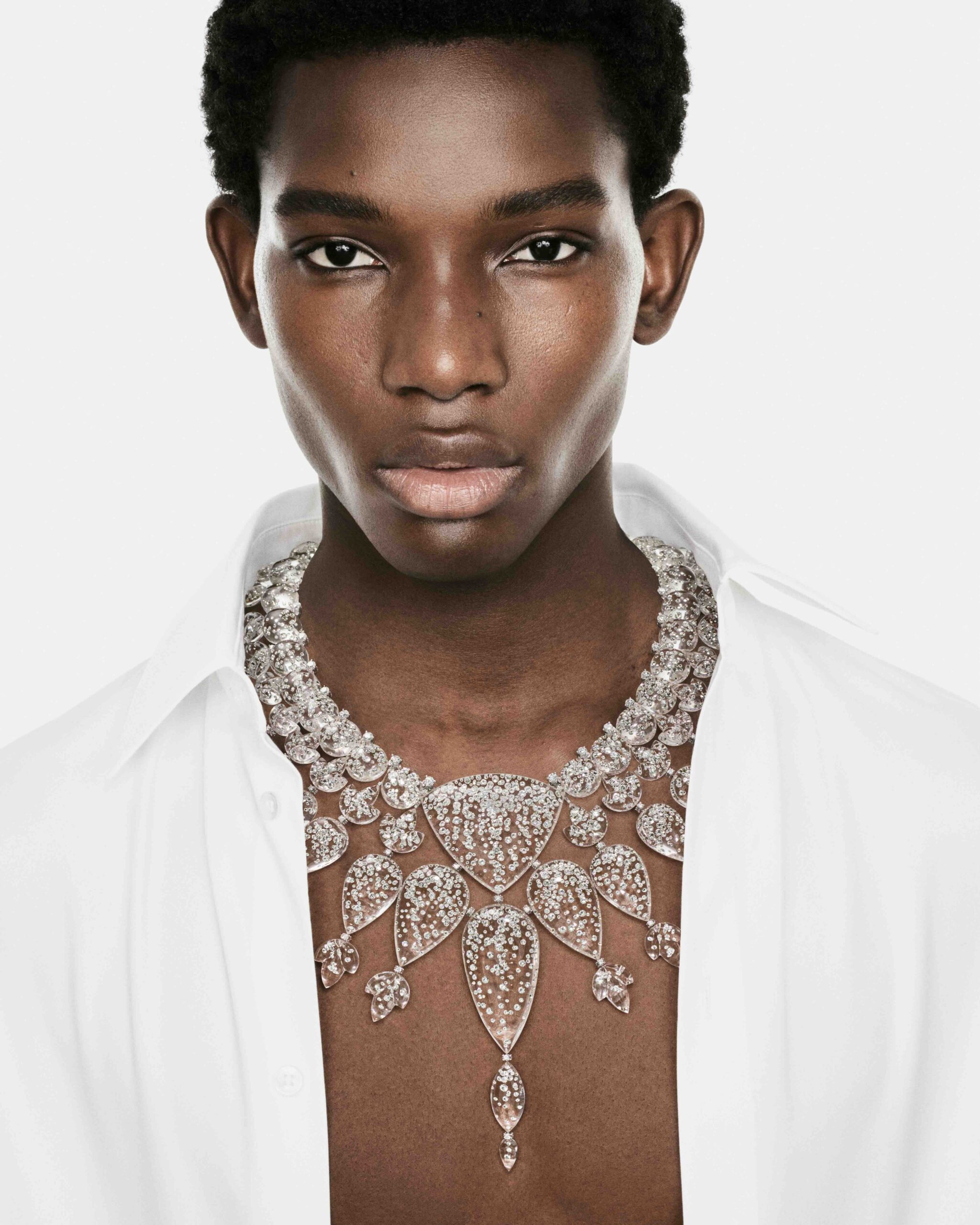
| Necklace set with rock crystal and paved with diamonds, in white gold. Around 1,300 hours of work. | |
SINGULARITY
With this first jewelry set, Claire Choisne sought to create the illusion of a cascade of diamonds raining down onto the skin. The material recedes, leaving the stones seemingly suspended in space and time. In a bid to heighten the sense of transparency, the Creative Director revisited a favourite material of the Maison’s, rock crystal.
SAVOIR-FAIRE
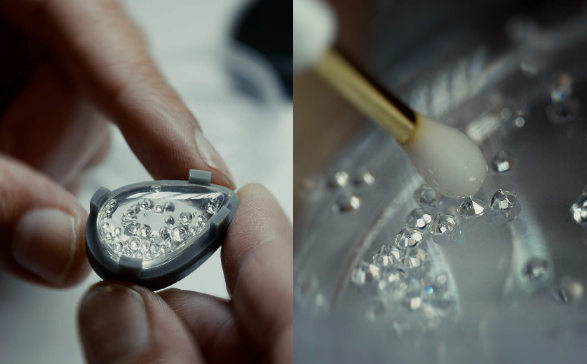
Encapsulation of diamonds within rock crystal droplets, in a plant-based resin
To mimic rain, Boucheron’s artisans first crafted hollow droplets out of rock crystal, into which they then poured successive layers of plant-based resin. Diamonds were painstakingly placed inside each droplet by hand, layer by layer and in a very specific order, to give a three-dimensional effect. Each diamond’s exact position was carefully planned by the artisans to evoke the soft, fluid movement of falling rain. This extremely precise process was carried out in a vacuum to prevent any microparticles or air bubbles from forming. Altogether, over 4,800 diamonds were set in place one by one, encased as though suspended within the rock crystal. Once each droplet had been crafted and sealed, they were linked together by an articulated metal spine that preserves the necklace’s supple fluidity. In pursuit of perfect transparency, the articulations were set with diamonds so the necklace’s structure seems to disappear.
FLOWER
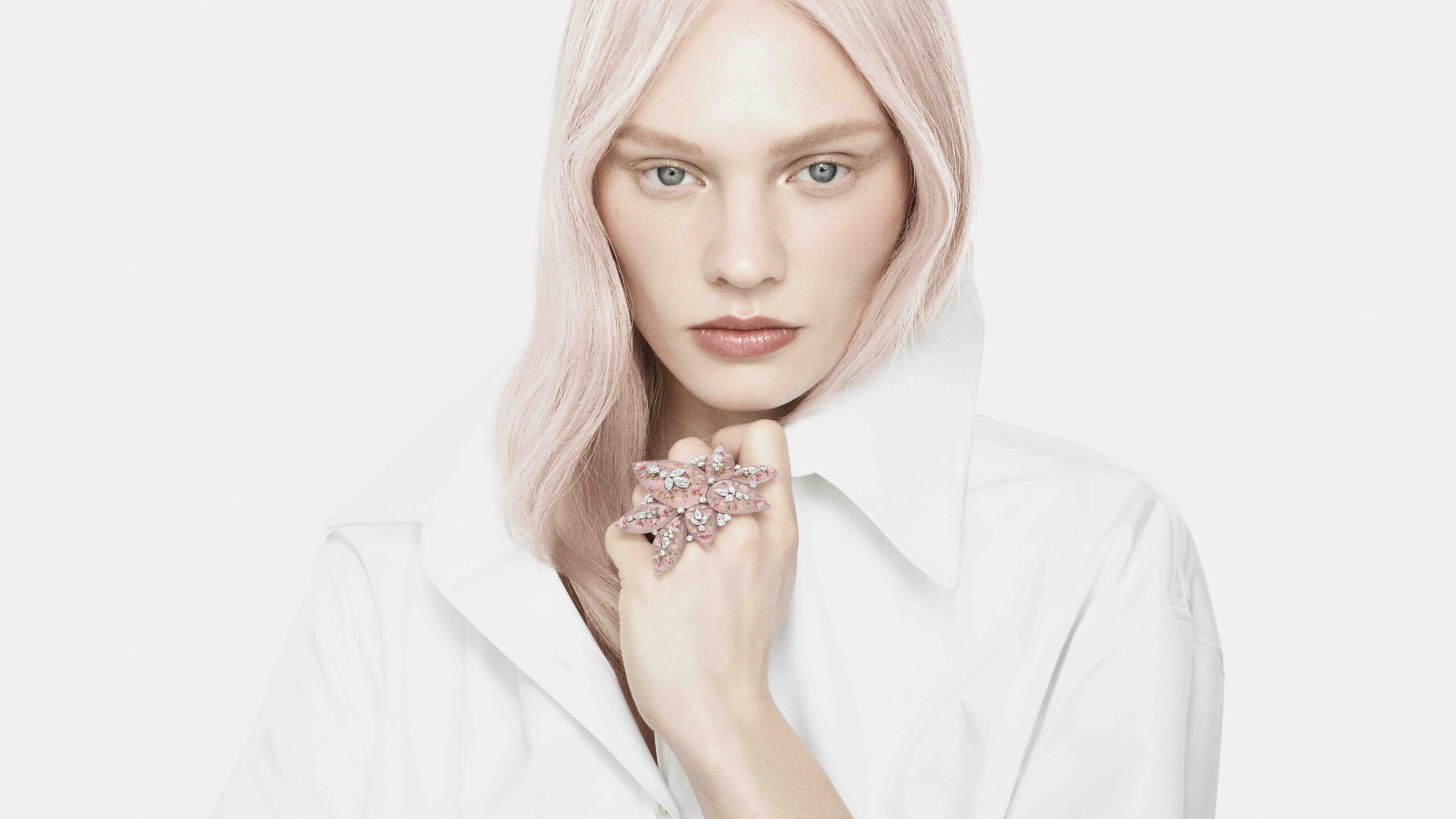
| Ring set with a 0.71-carat e vvs1 pear-cut diamond, pink quartz totaling 141 carats, paved with diamonds, in sapphire glass, in pink gold, white gold and platinum. Around 340 hours of work. | |
SINGULARITY
This set was inspired by a motif that the studio team designed like a richly patterned floral wallpaper. From tender bud to fully unfurled petals, each stage of a flower’s blossoming unfolds across the body in a symmetrical composition where the blooms seem to spring from the very stone itself.
SAVOIR-FAIRE
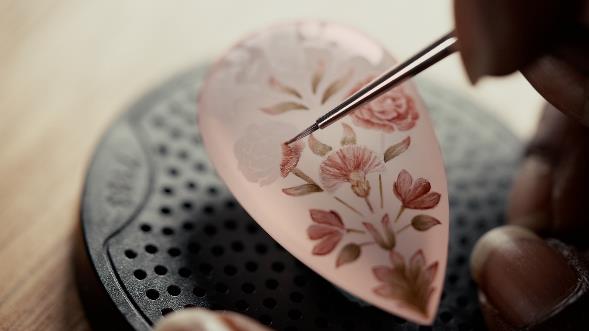
To bring this botanical design to life, Boucheron called on the skills of a painter of micro-miniatures. This extremely intricate art is executed at a tiny scale, using shadows and light to create the illusion of depth. Each rose quartz that makes up the set was painted individually under magnification. The artist applied the paint in delicate strokes, one after another, to perfectly reproduce the different shades of color. Painting in such microscopic detail posed a real challenge for the artist, as the floral motif had to be precisely replicated on every stone, and all entirely by hand. An equally critical and delicate stage was the application of the protective finishing varnish: achieving a flawlessly smooth surface, without a single air bubble, called for absolute technical mastery. Every stone took around ten hours on average to complete, from layers of micro-painting through to the matte-finish varnish, in order to achieve the desired delicacy, depth, and shades. This represents more than 1,200 hours of micro-painting work across the entire set. Added to this feat was the challenge of sourcing the rose quartz, ensuring a uniform color across the various sizes and shapes of stones. The textures were also subject to special treatment, alternating between polished and softly frosted surfaces to bring out the chromatic nuances of the micro-painting with even greater subtlety. The stones were individually pierced and mounted on a finely engineered pin framework, without visible claws or collets, to maintain the purity of the design. This metal structure was coated with a ceramic finish to match the color of the stones and ensure a harmonious overall effect.
LIGHT
 |
|
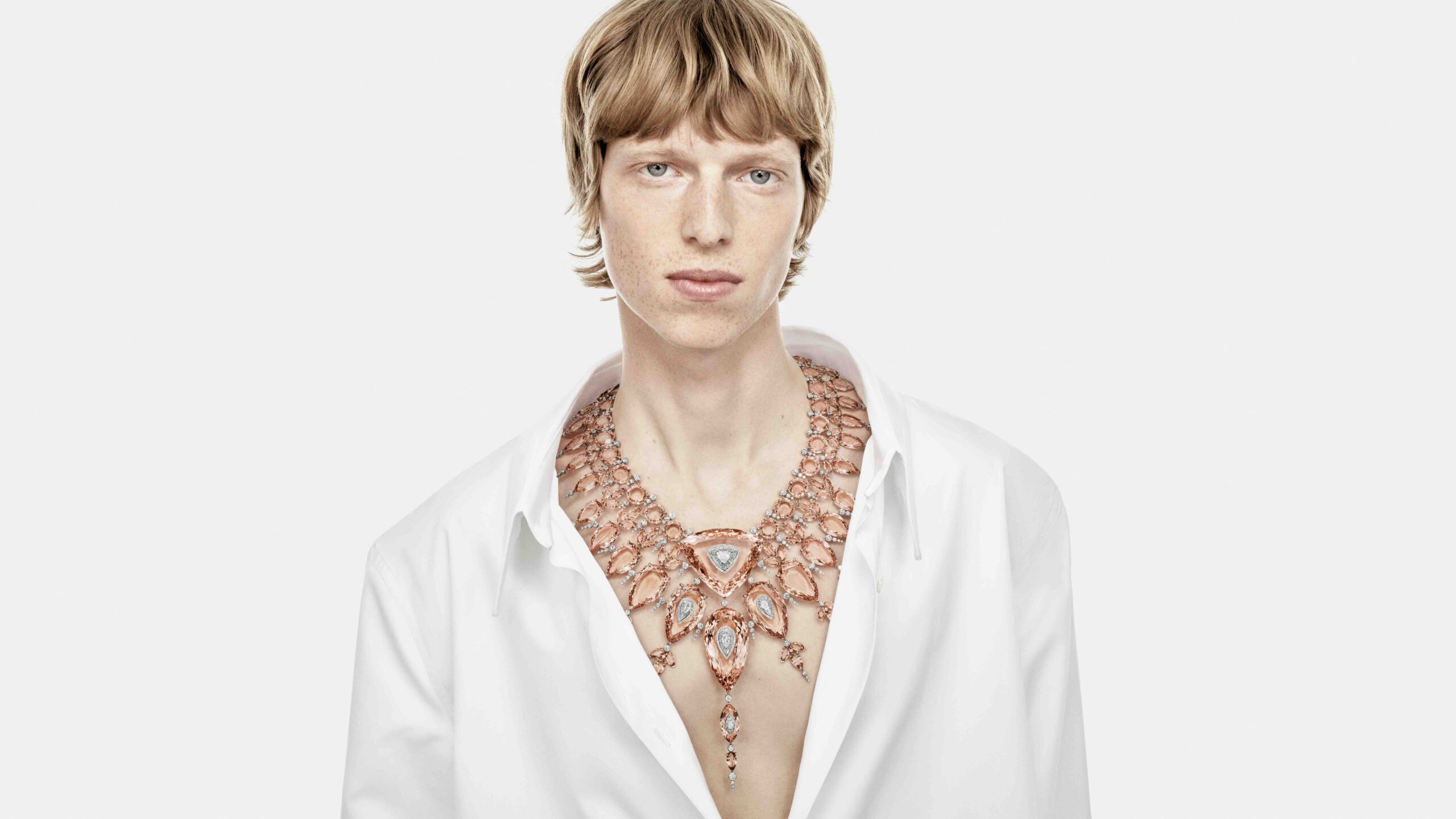
| Necklace set with a 1.34-carat d if troidia-cut diamond, morganites totaling 1,547 carats, paved with diamonds, in pink gold and platinum. around 3,200 hours of work. | |
SINGULARITY
This third set is all about light. The design plays with different sizes, shapes, positions and combinations of morganites – some set with diamonds – in a way that allows light to flow freely through the stones.
SAVOIR-FAIRE
To bring forth this light, the first step was to assemble a group of perfectly matched, uniform gemstones. It called for the most rigorous selection process to gather over 1,500 carats of morganites of the exact same color intensity, despite their natural variations. As the entire piece was conceived around light, perfection was imperative at every stage. The stones had to be cut with particular care to maintain overall harmony. Yet it was the mounting that posed the main challenge. Morganite is a vibration-sensitive gemstone, so using conventional hammering techniques might have compromised its internal structure.
Boucheron’s artisans therefore developed an alternative approach that showcases their technical virtuosity: to avoid any pressure being exerted on the morganites, they fitted and screwed the prongs around each stone. Another constraint added to the complexity. The design called for the diamonds to be directly set into the morganites that form the focal cluster. These stones were therefore hollowed out to accommodate a metal framework, into which the diamonds were then set with prongs and bezels.
TATTOO
 |
|
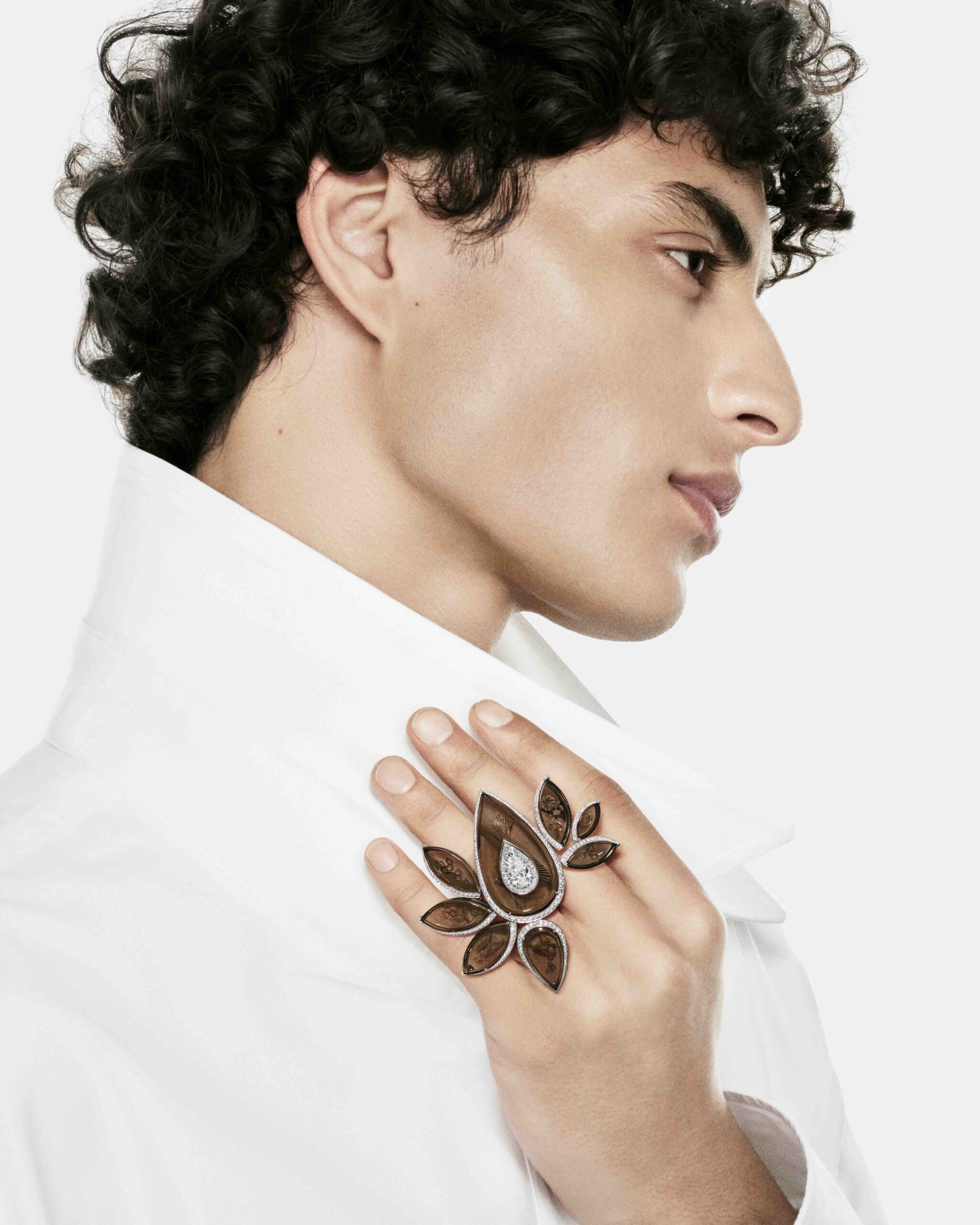
| Ring set with a 1.51-carat e if pear-cut diamond, smoky quartz totaling 83 carats, paved with diamonds, in sapphire glass, in white gold. Around 520 hours of work. | |
SINGULARITY
With this set, Claire Choisne sought to recreate the effect of tattoos on skin. The motifs that decorate these pieces were inspired by the aesthetic of Victorian-era tattoos. All are drawn from among Boucheron’s enduring favourites – poppy, rose, chickadee, cicada, snake, butterfly, foliage – with several directly borrowed from the Maison’s archives. These motifs unfold symmetrically from the centre outward on both necklace and ring, forming an ornamental composition seemingly traced onto the skin itself.
SAVOIR-FAIRE
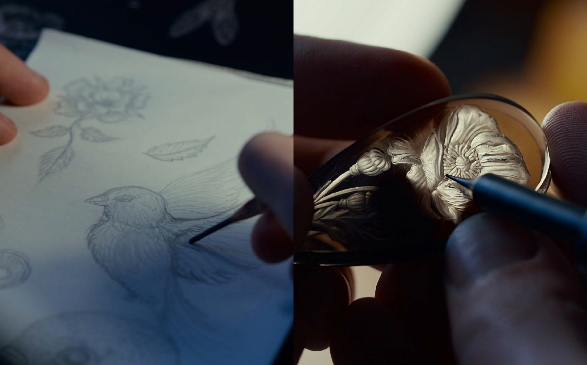
Stages of glyptic work on smoky quartz.
To create the illusion of a real tattoo, it wasn’t enough simply to engrave the smoky quartz – light needed to pass through it to bring out the motifs. Glyptic art was the obvious technique to use – an ancient craft whereby the stone is deeply incised to create a bas-relief effect. Each stone was patterned on its reverse side by a gem carver working in the glyptic tradition. Since this stone engraving technique doesn’t allow for the use of colour to bring out its finer details, these can only be revealed through subtle variations in depth, relief, and texture. This makes it a truly sculptural feat, where every line and variance in the surface is designed to catch the light and alter the way it’s perceived. The design comes to life thanks to the precision of the artisan’s hand and their mastery of three-dimensional form. To craft this set, they invented their own tools (more than 200 altogether), each tailored to a specific detail of the engraving. Quartz is a hard and unforgiving material, which meant that a constant succession of new tools had to be manufactured. As the stone wore them down, they would be remodelled, one after the other, becoming ever finer and more precise so the minutely intricate patterns could be rendered. This type of work calls for the utmost accuracy, as it is irreversible: it’s in the nature of stone that once anything is cut away, it cannot be recovered. The challenge lay in achieving perfect symmetry across the repeated motifs, as well as in engraving the smallest stones. Crafting this jewelry set took over 1,100 painstaking hours of glyptic artistry.
CHECKERS
 |
|
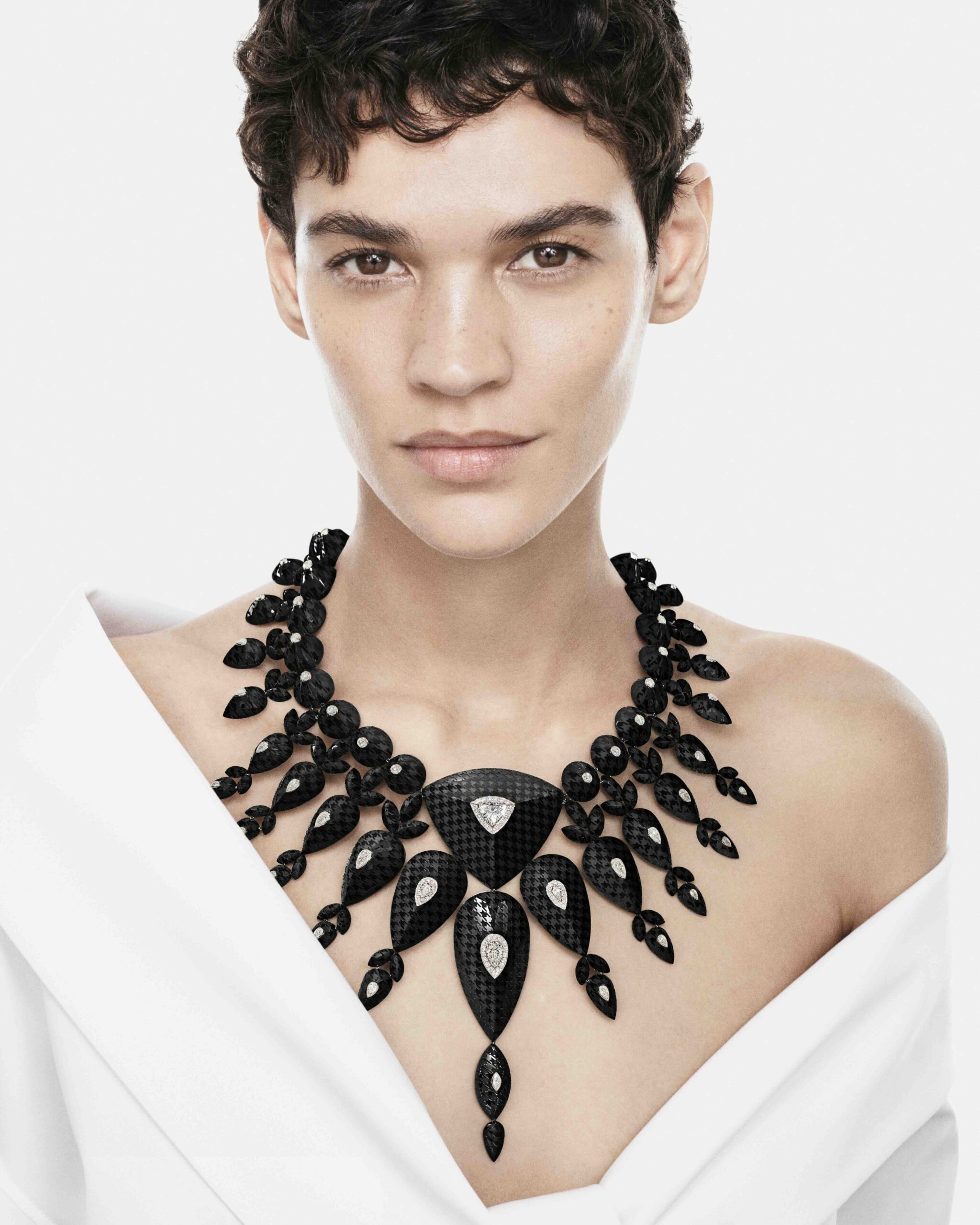
| Necklace set with a 2.63-carat d vvs1 troidia-cut diamond, onyx totaling 1,535 carats, paved with diamonds, in white gold. Around 1,700 hours of work. | |
SINGULARITY
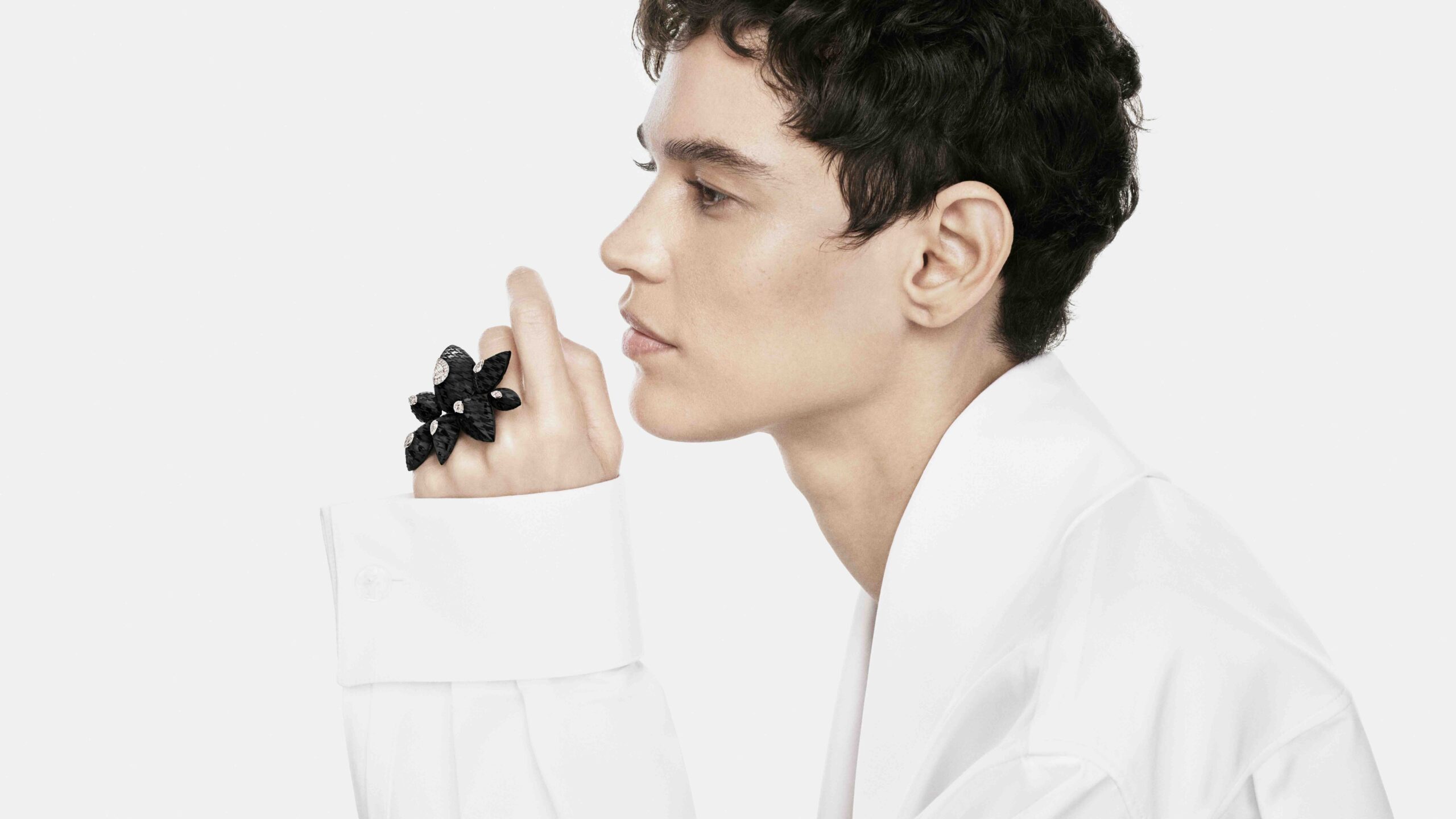
This last set takes a textile pattern that Claire Choisne is particularly fond of, houndstooth, and transposes it into stone. Thus, jewelry almost becomes garment, in a nod to the world of couture so dear to Boucheron. Here, the aim wasn’t simply to reproduce the pattern of the fabric, but to recreate its tactile quality through the engraving of the onyx.
SAVOIR-FAIRE
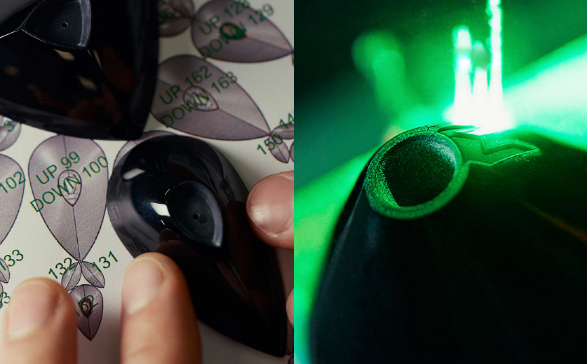
Stages of femtosecond laser engraving on onyx droplets.
To inscribe this pattern into the stone, Boucheron used a femtosecond laser, an incredibly precise technology commonly employed in watchmaking. The laser emits a series of ultra-fast micro-impulses that remove material from the onyx without heating it. Finding the right depth was the real challenge: deep enough to impart texture and relief to the pattern, yet not so deep as to weaken the stone. But the lasering itself wasn’t the only difficult part. The artisans also sought to create the illusion of a genuine houndstooth weave draped across the necklace, so that, when viewed head-on, the eye perceives a single uninterrupted pattern flowing seamlessly from one droplet to the next, front and back alike. To achieve this effect, each of the 163 stones was individually designed and treated. The pattern couldn’t be exactly identical on every droplet, as this would have disrupted the visual continuity, so all the droplets in the set were individually engraved on their particularly challenging conical surfaces. Extensive cad modelling was used to ensure the pattern’s overall uniformity and create a flawless optical effect. In addition, 163 custom-made setting tools were created, as each stone’s individual shape required its own unique calibre, to enable the engraving to be executed with utter precision. The six central onyxes were also hollowed out to make the piece lighter.
THE CAMPAIGN
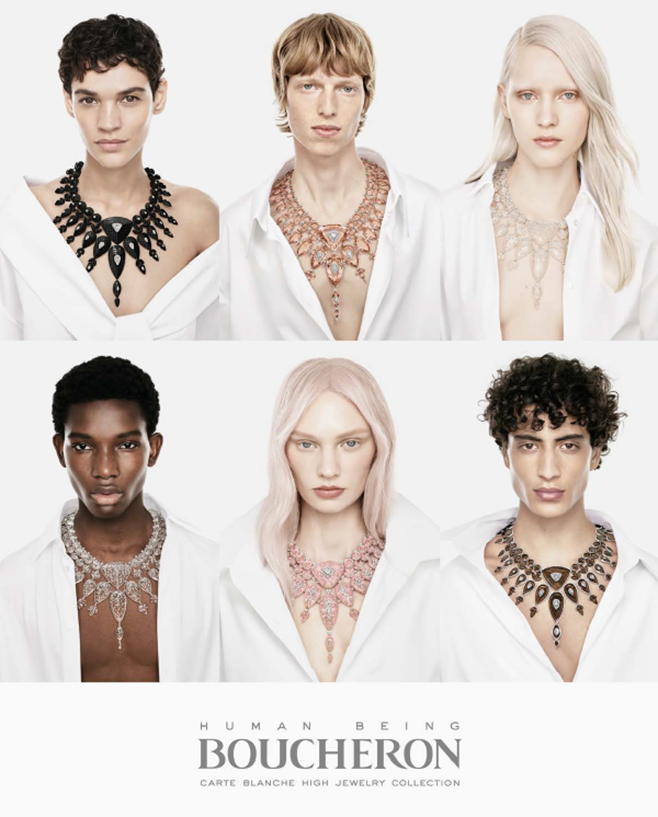
Boucheron showcases this collection in a resolutely contemporary campaign that presents all the pieces, highlighting both their similarities and their distinct characters. Six models are first shown in a deliberately uniform setup – same gaze, same posture, each in a white shirt. This pared-back aesthetic brings into focus what we have in common. Then the static image gives way to video, and those same models show us, through their expressions and movements, what makes each of them uniquely different: their emotion and joy.