
26 May 2026 By AWAY IN STYLE
Burj Khalifa in Dubai is the most Instagrammable landmark in 2026
For the first time, Google reports that Gen Z is more likely to discover travel destinations through TikTok and Instagram than through search. As travel discovery moves from search engines to social feeds, a striking image now travels further than any tourism campaign. With this in mind, I am sharing our new report mapping the world’s most Instagrammable destinations in 2026.
To compile the report, the team at PlayersTime developed a bespoke Instagrammability Score, combining global monthly Google search demand analysed via Ahrefs Keyword Explorer with cross-platform hashtag volume measured across Instagram and TikTok. The Index covers over 240 locations across three categories: cities, landmarks, and unusual places. All metrics were normalised to a 0-100 scale and combined into a single score, with Instagram hashtag volume given additional weighting to reflect its continued role as the primary platform for travel inspiration. The full dataset is available via Google Drive via this link.
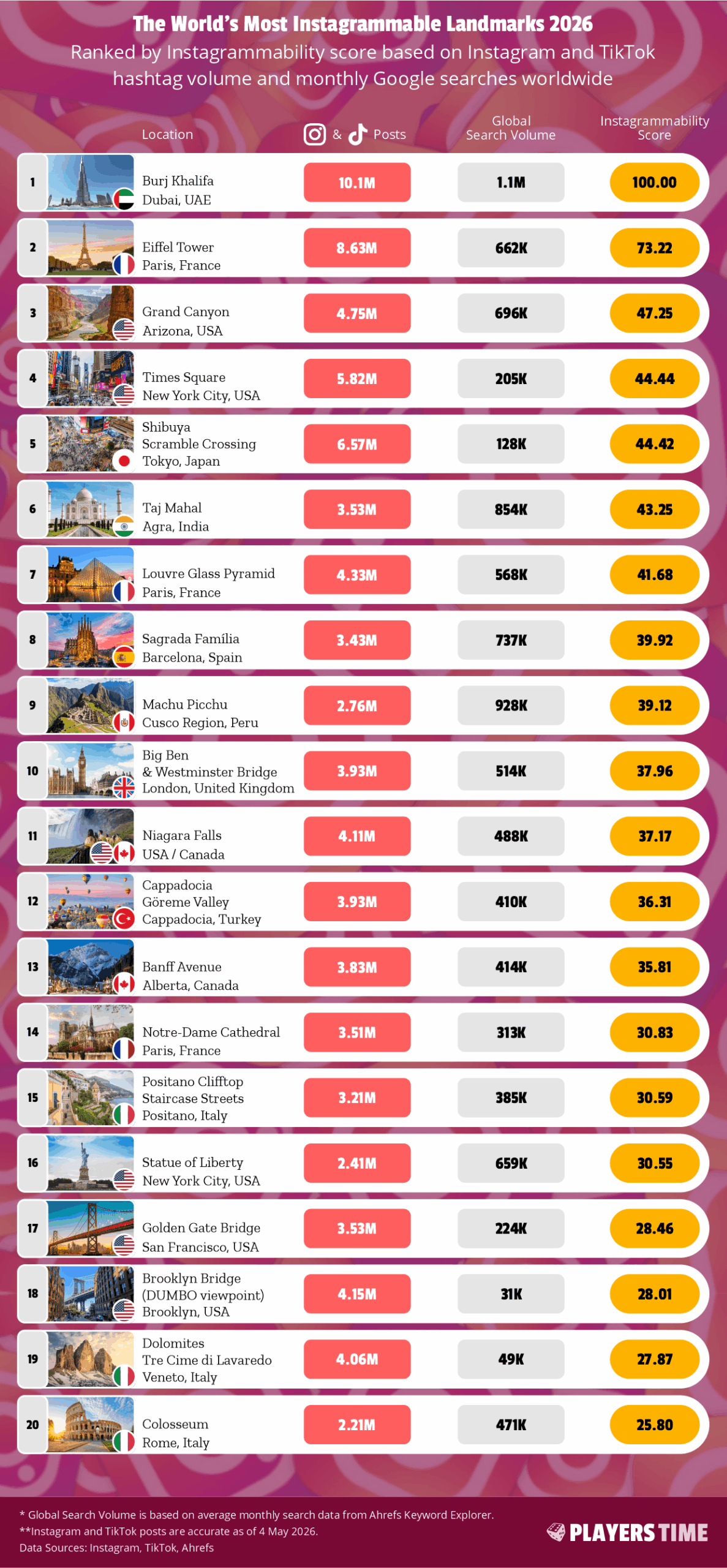
Burj Khalifa, the world’s tallest building, leads the global landmarks ranking with a perfect score of 100, backed by over 10.1 million tagged posts and 1.1 million monthly Google searches, the only landmark in the entire dataset to surpass one million searches. It is followed by the Eiffel Tower with a score of 73.22, a result that will surprise no one, but whose consistency across both social media and search volume reflects the endurance of certain global icons.
Other highlights from the report:
- Burj Khalifa is the most popular landmark on social media globally with an Instagrammability score of 100. It has been featured in over 10.1 million tagged posts across Instagram and TikTok, and is the only landmark in our analysis to surpass one million monthly Google searches, recording 1.1 million.
- Dubai, home to the iconic Burj Khalifa, also leads the global city ranking with another perfect score of 100, making it the most Instagrammable city in the world. It is the only destination to top two separate categories in our report.
- The Eiffel Tower follows as the world’s second most Instagrammable landmark with a score of 73.22 in our Index. It has been tagged in 8.63 million posts, while generating an average of 662,000 monthly Google searches, a result that reflects the endurance of certain global icons. This result establishes Paris as the most represented city in the entire landmarks ranking, placing three entries in the global top 20.
- The Grand Canyon South Rim takes third position with a score of 47.25, driven by 4.75 million tagged posts and 696,000 monthly Google searches. It is followed closely by another U.S. location, the famous Times Square in New York, ranking fourth with an Instagrammability score of 44.44, owing to 5.82 million tagged posts and 205,000 monthly Google searches. Times Square features the most social media posts of any American landmark in our analysis.
- Europe places eight landmarks in the global top 20, more than any other continent, with France alone accounting for three entries (Eiffel Tower, Louvre Glass Pyramid, and Notre-Dame Cathedral), making Paris the most represented city in the entire landmarks ranking.
- Across the ranking, Machu Picchu is the only South American entry in the global top 20, scoring 39.12 points on our Index with 2.76 million posts and 928,000 monthly searches, one of the few landmarks in the entire dataset where cultural significance and social media enthusiasm align in equal measure.
- The Dolomites Tre Cime di Lavaredo, part of a UNESCO World Heritage Site spanning five Italian provinces, generates 4.06 million tagged posts with just 49,000 monthly searches, the widest gap between visual reach and search demand of any entry in the top 20, and the clearest example of a destination discovered through feeds rather than search.
‘In 2026, destinations are being experienced long before anyone actually visits them. Through thousands of near-identical images, certain places become instantly recognisable, shaping expectations in advance. By the time people arrive, instead of discovering something new, they are stepping into a version of what they have already seen countless times.
That effect is now intensifying. AI-generated travel content has begun to flood the same feeds that once belonged exclusively to real visitors, and as platforms like TikTok continue to accelerate the speed at which a destination can go from unknown to overwhelmed, the gap between a place’s visual reputation and its ability to absorb the attention it attracts will only widen. The destinations that figure out how to manage that gap, not just chase it, will be the ones that define what this ranking looks like in five years.’
– comments Silvana Vladimirova, data analyst at PlayersTime.
More information, including full city and landmark rankings, regional breakdowns, and the unusual places index, can be found in the complete report. The raw dataset is also available via the following Google Drive link. You are welcome to use any data or graphics for publications, provided that a link to the original PlayersTime report is included for attribution.